
Choosing the right CCTV cameras for your business in Oman
Dome or bullet, IP or analogue, 2MP or 4K. Here is how to pick cameras that actually see what you need them to see, and survive an Omani summer while doing it.
Start with what you need to see, not with a camera model
Most people begin choosing CCTV by comparing camera models. That is the wrong end of the problem. Start instead with a short list of the things you would want on video if something went wrong: who came through the front door, who was at the till at the moment cash went missing, which vehicle reversed into the gate, whether the stock room was opened after hours. Each of those is a different job, and each job points to a different camera.
A camera that gives a nice wide view of a showroom will not tell you who took a phone from the counter. A camera tight enough to identify a face at the entrance will not cover the rest of the shop. Getting this right at the start is what separates a system you actually use from four cameras that record a blurry version of nothing in particular. When we quote a CCTV and security camera system, the walk around the site is mostly this conversation.
IP or analogue, and what that choice really means
The first fork is how the camera sends its picture to the recorder. Analogue cameras send video over coaxial cable to a DVR. IP cameras send it over normal network cable to an NVR, and take their power from the same cable, which is why one cable per camera is enough.
For a new installation, IP is almost always the sensible choice. You get higher resolutions, one cable per camera, and the flexibility to add cameras later without re running everything. It also means your cameras live on your network, so tidy network cabling and switching is part of the system rather than an afterthought.
Analogue is not automatically the wrong answer. If you have taken over premises that already have coax run through finished walls and ceilings, modern HD over coax cameras can give you a genuine picture upgrade on the cabling that is already there, at a fraction of what rewiring would cost. That is a real saving, and it is worth asking about before anyone starts pulling out old cable. What you should not do is buy new analogue for a new building to save a little on the initial bill.
The shapes, and what each one is honestly for
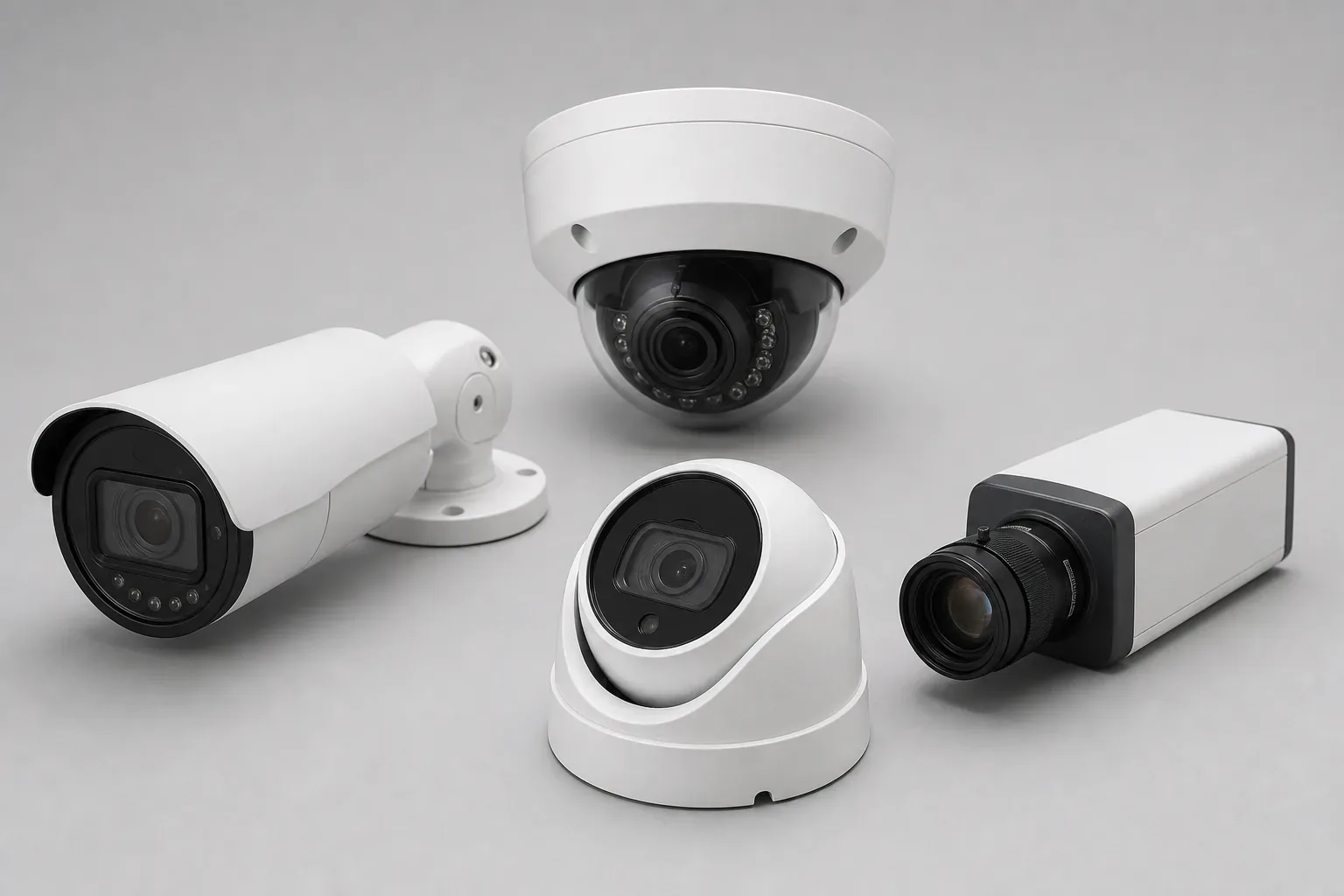
Camera types look like a catalogue problem. In practice there are four you will actually choose between.
- Dome cameras sit flush against a ceiling under a tinted cover. They are unobtrusive, hard to tell where they are pointing, and awkward to knock out of alignment. They suit shop floors, offices, receptions and corridors.
- Turret cameras, sometimes called eyeball cameras, are the ball in a socket shape. They give better night pictures than domes because the infrared sits outside the glass cover, so you avoid the internal glare a dome can suffer. They are becoming the default indoor and sheltered outdoor choice.
- Bullet cameras are the visible cylinder on a bracket. They are easy to aim at a specific line, come with a sun shield, and are the obvious pick for perimeters, car parks, yards and gates. Being visible is a feature here, since a camera people can see is part of the deterrent.
- PTZ cameras pan, tilt and zoom under control. They are useful over a large open area such as a yard, compound or car park, where an operator or a preset patrol can follow something. They are not a replacement for fixed cameras, because a PTZ pointing left is not recording what happens on the right.
There are also panoramic and multi sensor cameras that cover a wide area from one mounting point, and number plate cameras built specifically to read plates on moving vehicles. Both solve real problems, and both cost more, so they belong where the job genuinely calls for them.
Resolution and lens: the part most quotes get vague about
Resolution alone tells you very little. What matters is how many pixels land on the thing you care about, and that depends on the lens and the distance as much as the sensor.
The useful way to think about it is in three levels. You can cover an area well enough to see that something happened. You can cover it well enough to recognise a person you already know. Or you can cover it tightly enough to identify a stranger from the footage. Identification needs far more detail on the subject than most people expect, which is why the entrance camera should be framed narrowly on the doorway rather than trying to watch the whole reception at the same time.
That leads to two practical rules. First, do not buy the highest resolution for every position. Higher resolution multiplies your storage and your bandwidth, and a 4K camera aimed at a wide car park still will not read a plate. Put the detail where you need detail. Second, prefer varifocal lenses on the positions you are unsure about, because they let the installer set the exact field of view on site instead of hoping a fixed lens frames it correctly. Higher resolutions also change how much recording space you need, which we cover in the NVR and cloud storage guide.
Night, sun and the Omani conditions your cameras have to live in
Two lighting problems cause most of the disappointing footage we see, and both are predictable.
The first is night. Infrared gives you a usable black and white picture in darkness, and every serious camera has it, but the stated range assumes an open space with something to reflect the light back. In a long yard with nothing nearby, the picture goes dark much sooner. Where you need colour at night, for clothing or a vehicle colour, you need a low light colour camera or a camera with its own white light, plus some ambient lighting.
The second is glare, and in Oman it is the bigger of the two. A camera watching a glass entrance with the morning sun behind it will show you a silhouette and nothing else. The feature that fixes this is wide dynamic range, and it should be on the specification for any camera pointed at a door, window or shutter that faces daylight.
Then there is simply the climate. Anything outdoors needs a weather rating suitable for dust and driven rain, a sun shield, and a housing rated for the temperatures it will actually sit in on a west facing wall in July. Coastal sites in Muscat, Sohar and Salalah add salt air, which quietly corrodes cheap brackets and connectors long before the camera itself fails. Where the camera is reachable from the ground or sits in a public area, an impact rating is worth the small extra. Consumer cameras bought online are usually where this goes wrong, because they are specified for a mild climate and an indoor life.
A few things worth checking before you sign
- Open standards. Cameras that speak a common protocol such as ONVIF can be mixed and matched, and can usually be moved onto a different recorder later. Fully closed systems lock you to one supplier for every future camera.
- Power. With IP cameras, the switch has to supply enough power for every camera on it, and heaters or PTZ motors need more. A switch that is at its limit is a system that drops cameras on hot afternoons.
- Warranty and who honours it. A camera warranty is only useful if someone local will climb the ladder. Ask who handles a failure in month fourteen.
- How you will watch it. Mobile viewing that works reliably from outside the building, and clear rules on who can see what, matter more day to day than a specification sheet.
- Who maintains it. Lenses gather dust, hard drives wear out, and firmware needs updating. Whether that sits with you or with an ongoing IT support arrangement is worth deciding before install day, not after the first failure.
The short version
Pick cameras by the job each one has to do. Choose IP for anything new, keep good coax if you inherited it, use turrets and domes inside, bullets on the perimeter, and spend your resolution where identification actually matters. Specify wide dynamic range wherever daylight is in the frame, and buy for the heat, dust and salt rather than for the picture on the box. If you would like a second opinion on a quote you have been given, or a plan for a site that has never had cameras, book a free CCTV site survey. We look first and quote after, at no cost. Our full CCTV service covers the design, the install and the years after it.
Get a quote for your setup

Amirh. Safavi
Founder
Amirh. Safavi is the founder of BudTech LLC, an IT and software company in Muscat founded in 2026, and writes its guides to business IT in Oman.
More from Amirh. Safavi