
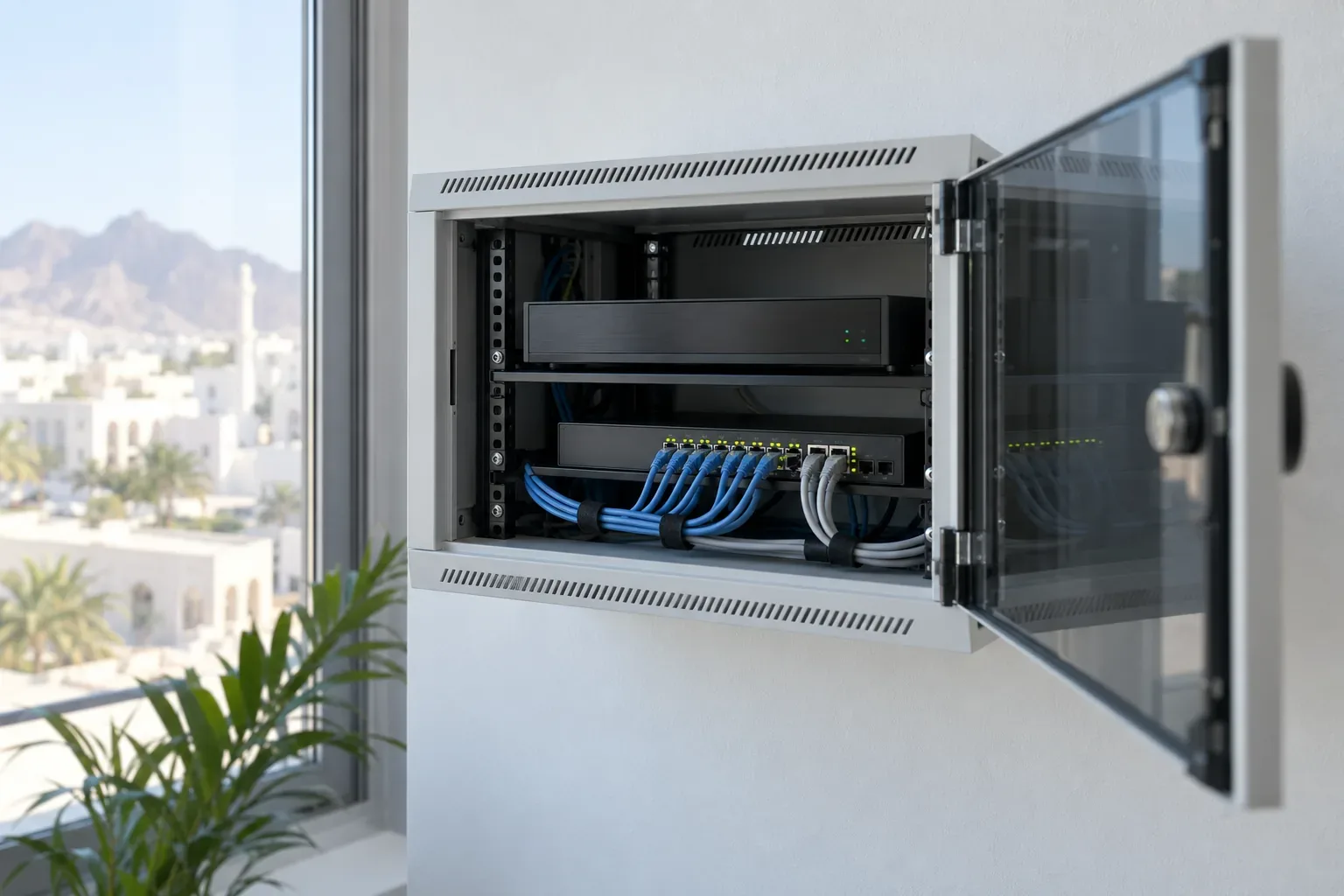
NVR or DVR: which CCTV recorder suits your business in Oman?
A DVR records analogue cameras over coax, an NVR records IP cameras over the network. Here is how each works, when a hybrid makes sense, and how to choose for a shop, an office or a warehouse in Oman.
The short answer
Both recorders do the same basic job: they take the video from your cameras and write it to hard drives on site. The difference is the kind of camera each one records. A DVR (digital video recorder) records analogue cameras, including modern HD-over-coax models, connected by coaxial cable. An NVR (network video recorder) records IP cameras, which send their video as data over ordinary network cable. For a new installation, an NVR with IP cameras is almost always the better choice. If your premises already have coax in good condition inside finished walls, a hybrid DVR can be the cheaper route to a sharper picture, and a reasonable stepping stone towards IP later.
Where the recordings should be kept, on the recorder or in the cloud, is a separate decision, covered in NVR or cloud storage for your CCTV.
How each recorder handles the video
With a DVR, the camera sends an analogue signal down the coax and the recorder does the heavy lifting: it converts the signal to digital video, compresses it and saves it. Each camera also needs its own power, usually from a power supply near the recorder. Analogue HD has improved a great deal. Hikvision's datasheet for its iDS-7108HQHI-M1/S DVR lists coax inputs at up to 5 MP.
With an NVR, the camera does that work. Each IP camera compresses its own video and sends it across the network, and the recorder receives, stores and manages the streams. One network cable per camera carries the video and the power together. Because the cameras sit on a network, they do not all have to run back to the recorder: they can join through a switch in another part of the building. Higher resolutions are easier to reach too. Hikvision's DS-7608NXI-K1/8P datasheet lists recording at up to 12 MP on a compact 8-channel NVR.
Hybrid and XVR recorders: when keeping the coax makes sense
Many recorders sold as DVRs today are really hybrids. The Hikvision DVR above accepts four analogue formats (HDTVI, AHD, CVI and the older CVBS) on its 8 coax inputs, and records IP cameras over the network as well: 2 as standard, and up to 12 in some configurations, according to its datasheet. XVR is a name some manufacturers give this kind of recorder: one box that takes several analogue formats and IP cameras together.
Most new systems we install as business CCTV and security camera systems are IP cameras on an NVR, but a hybrid makes sense when:
- the coax already runs through finished walls and ceilings, and replacing it would mean opening them up
- the cable is in good condition, with sound connectors and no sign of water or corrosion
- the cameras are for general coverage, not for reading faces or number plates at a distance
- you want to add a few IP cameras now, for a new gate or loading bay, without replacing the whole system
It makes less sense in a new building, where cable is going in anyway and network cable is the better choice from day one, or where the old coax is of unknown age and quality. Which cameras to fit, whatever the recorder, is covered in choosing the right CCTV cameras for your business in Oman.
PoE, cabling and the power budget
Power over Ethernet (PoE) is what lets one network cable carry both video and power to an IP camera. The IEEE standardised it as 802.3af in 2003 and extended it as 802.3at, known as PoE+, in 2009. The task force's published objectives show a device drawing up to 12.95 W working on an original 802.3af port, while PoE+ ports supply more: Hikvision's datasheet for its DS-3E0318P-EL/M(B) switch, for example, rates each PoE+ port at up to 30 W.
In practice, the budget matters more. An NVR's built-in PoE ports share one budget: the 8-port Hikvision NVR above lists 75 W in total, less than 8 cameras each drawing 12.95 W would need. Cameras with heaters, strong infrared or pan and tilt motors draw more, so add up each camera's maximum from its datasheet before choosing. When the budget runs out, a camera goes dark.
Built-in ports or a separate switch:
- Built-in PoE ports suit a shop or small office, where every camera can cable straight back to the recorder.
- A separate PoE switch suits larger sites, where cameras are spread out and can join the network near where they are mounted, and where a bigger power budget is needed.
- Long runs across a warehouse or yard need planning, because network cable has a maximum length per run. The usual answers are a switch in a cabinet nearer the cameras, fibre between buildings, or a switch with a long-range mode: the Hikvision switch above quotes up to 300 m in its extend mode.
A DVR's cameras need their own power too, so a hybrid upgrade only saves money if the existing coax and power are both usable. Either way, tidy labelled cabling is part of business network setup and structured cabling.
Picture, storage and life without internet
HD over coax is adequate for general coverage of a room or a corridor. Where you need to identify a face at a door or read a number plate at a gate, use an IP camera.
Both store video on hard drives inside the recorder. The two small Hikvision recorders above each take a single drive of up to 10 TB, so if it fails, recording stops until it is replaced; larger recorders take several drives and can be set up to survive one failing. An NVR also has a ceiling on total incoming video, 80 Mbps on the 8-channel model above, which matters if you plan to add high-resolution cameras later.
Without internet, both keep recording as long as they have power, and you can still watch and play back footage on a monitor connected to the recorder. What stops is anything that leaves the building: viewing from your phone when you are away, phone alerts, and the recorder setting its clock from an internet time server. A power cut is different: recording stops unless the recorder and the PoE switch are on a UPS.
Lifespan, heat and when to replace
There is no fixed lifespan for a DVR or an NVR. The part that wears out is the hard drive, which writes video around the clock. What usually ends a recorder's life is a limit rather than a fault: it has no free channels for the cameras you want to add, it cannot take the resolution of newer cameras, or the manufacturer has stopped releasing firmware for it, which leaves known security holes unpatched.
Heat shortens the life of both. The two Hikvision datasheets above give the same working range for their recorders, -10 °C to 55 °C. A recorder shut in a cupboard with no airflow, next to a router and a PoE switch, runs far warmer than the room around it. Put it in a ventilated cabinet or an air-conditioned comms room, away from dust, and check it on every CCTV maintenance visit.
Upgrade paths, from cheapest to most complete:
- Keep the coax, swap old analogue cameras for HD-over-coax ones, and replace the recorder with a hybrid.
- Add IP cameras on the hybrid's IP channels for new positions, through a PoE switch.
- Move to a full NVR when the remaining analogue cameras reach the end of their life, re-cabling one area at a time.
Choosing for a shop, an office or a warehouse in Oman
We install both types as a Hikvision partner (Hik-Partner Pro), and the right one usually comes down to the site:
- A shop or small showroom. Usually around four cameras: the door, the till and the aisles. An NVR with built-in PoE ports keeps it to one box and one cable per camera. Mount the recorder out of customers' reach, somewhere cool. Our CCTV Starter package is built for this: up to 4 IP cameras with an NVR, supplied, installed and set up, from 180 OMR, as listed on our CCTV and security cameras page.
- An office. An NVR in the comms cabinet with a separate PoE switch, and spare channels for the cameras you will add as the office grows. If you have taken over premises with working coax from a previous tenant, a hybrid recorder can reuse it for the corridors while new positions go IP.
- A warehouse or yard. Long cable runs, dust and direct sun. Plan switches in sealed cabinets nearer the cameras, fibre between buildings, outdoor-rated cable, and a recorder in the coolest room on site rather than a hot mezzanine office. Wide areas usually need higher resolution, which points to IP.
Frequently asked questions
Who is best, DVR or NVR?
For a new installation, an NVR with IP cameras, because it handles higher resolutions, carries power and video on one cable and grows more easily. A DVR, ideally a hybrid, is the sensible choice when good coax is already in the walls and the cameras are for general coverage.
What is the lifespan of a DVR?
There is no fixed figure. The hard drive inside usually needs replacing first, and the recorder itself tends to be retired when it runs out of channels, cannot take newer cameras or stops receiving firmware updates. Keeping it in a cool, ventilated spot helps it last.
Which is costly, NVR or DVR?
A DVR system often costs less at the start, mainly where existing coax can be reused and no new cable has to be run. An NVR system often costs more up front but saves a second round of spending when you later want higher resolution or more cameras, so compare the cost over the years you expect to keep it.
Can NVR work without internet?
Yes. An NVR records to its own drives over your local network, so it keeps recording when the internet line drops, and you can still watch on a screen connected to it. Until the line returns, you lose viewing from your phone away from site, phone alerts and automatic time setting.
What is an XVR?
XVR is a name some manufacturers use for a hybrid recorder: one box that records several kinds of analogue HD camera over coax and a number of IP cameras over the network. It suits a site with working coax that wants to move towards IP in stages.
Get a quote for your setup

Amirh. Safavi
Founder
Amirh. Safavi is the founder of BudTech LLC, an IT and software company in Muscat founded in 2026, and writes its guides to business IT in Oman.
More from Amirh. Safavi